
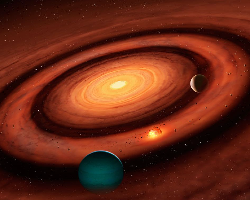
Protoplanetary Disks
I conduct research on planet formation theory using high-resolution hydrodynamical simulations. I have run simulations of the streaming instability to investigate the discrepancy between the dust mass in protoplanetary disks and that of evolved exoplanet systems (also known as the "missing-mass problem"). Using high-resolution hydrodynamical simulations of the streaming instability, I modeled multi-species particle interactions with self-gravity and then applied radiative transfer techniques to compute output intensities and approximate observed disk masses. By comparing these approximations to the true mass in the simulations, I quantified the observational mass bias introduced by overdense structures during early planet formation.
To support this work, I developed protoRT, an open-source Python toolkit for radiative transfer and mass analysis in planetesimal formation models. The published paper, which introduces this codebase and shows that observational correction factors of up to an order of magnitude are necessary, is available here. In an upcoming work, I will be presenting a machine learning-based inverse framework to map exoplanet observables directly to their initial birth conditions. Using over 7,000 simulations and JWST data, this work will demonstrate that while planetary formation erases many initial disk properties, atmospheric chemical tracers reliably reveal a planet's origin. The entire framework will be publicly available for future inference studies.